Tuesday, March 11, 2008

Multiple rainbows

Jan. 12, 2008
Riding home on the bus this afternoon, I noticed the rainbow off to the East. The sun was low in the west and was not far from setting, so the clouds were beginning to take on a golden hue. The rainbow looked like it was repeated numerous times and fading off in the distance. I got off at the next stop and pulled out my new pocket-sized digicam and snapped a couple of pics. I checked out Les Cowley's Atmopsheric optics page and it seems that the closest thing I could find were supernumerary bows, but these seemed to be more spaced out than the examples on his website. So is that what these are? I have included two pictures (1 2) and two contrast enhanced b&w versions of the pictures to better show the details (1 2).
Picture details: Canon SD1000, ISO 200, 1/160 sec, f4.9

Author: Darryl Luscombe, Vancouver, British Columbia, Canada

Thursday, February 28, 2008

Aircraft Iridescence

While taking wildlife pictures in a nature reserve close to the Vienna, Austria, airport, Franz Kerschbaum noticed this 747 jet aircraft in a landing approach with a huge condensation cloud behind its wings. As it moved closer to the runway, he was evidently at just the right position for this shocking but beautiful artificial iridescent cloud to come into view. Iridescence and coronas are diffraction phenomena. The pastel or metallic colors result from deflection of sunlight about minute water droplets.

Photo details: Canon EOS 30D camera, 100-400 mm/4.5-5.6L lens at 400 mm and f/8.0

Wednesday, February 27, 2008

Unusually bright twilights over Western Europe

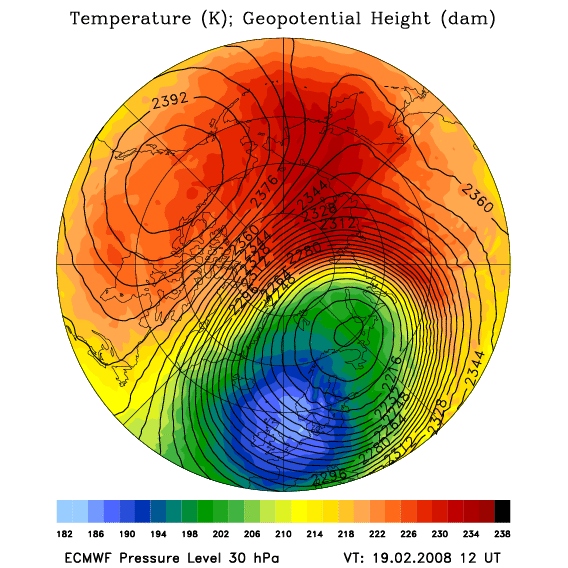
Between February 17 and February 20, 2008, large parts of Western Europe witnessed a series of unusually bright morning and evening twilights.
A few minutes after a quite normal sunset, the western skies began to burn in a strange yellow light which was bright enought to illuminate the landscape and giving a quite unreal touch to houses and trees.
Some minutes later, the yellow light in the west became surrounded by a brownish rim, turning into purple within some minutes. The yellow part of the sky slowly shrank towards the horizon, turning into orange and later into red and crimson. Some observers also reported of a dark, brownish-red light in the east which surrounded the whole horizon reaching up to 10° high.
The strange lights and colours in the sky were visible for up to about one hour after sunset. A similar “light-show” also appeared in the morning, starting with a crimson light over the eastern horizon and ending with the bright yellow light short before sunrise. The yellow illumination of the landscape could even be perceived through layers of low clouds (stratus) in some areas.
The phenomenon was reported from the British Isles, Scandinavia, The Netherlands and Germany, and there are even reports of unusual twilight observations from northern Spain.

These in some cases weird-looking twilights were probably caused by an outbreak of polar stratospheric clouds (PSC). These form at temperatures below -78°C in the stratosphere, at an altitude of about 20 – 25 km above the ground.
Soundings made at several stations showed that temperatures in the stratosphere really were unusually low over western Europe; up to -87°C (De Bilt) were measured, the lowest since measurements began in the 1980s. This makes the formation of PSC over a large area possible. Some photographs also show faint structures in the light, giving hints that they actually were caused by PSC.

Polar stratospheric clouds have never before been observed so far south. Normally, they can only be seen from Scandinavia, Canada and Alaska. Only in 1999 there was a confirmed observation of PSC from northern Germany.

Authors: Peter Krämer, Bochum & Claudia Hinz, Brannenburg

Sunday, February 17, 2008

Unusual corona around the moon

In the evening of February 14, 2008, an orographic cloud similar to this one formed above a sea of clouds under the influence of foehn wind above Mt.Wendelstein (1838m) in the Bavarian Alps. In this orographic cloud, an corona appeared around the moon which was more intensive and larger than any corona I had seen before. 4 systems of rings were clearly visible. The intensitiy leads me to the conclusion that all water droplets in the cloud were of the same size.

As I had a position very close to the cloud, the corona was extraordinarily large. A comparision to the constellation of Orion shows that it had a diameter of more than 20°. Below its lower part, the corona turned into a faint pink and green iridescence, indicating that the droplets were smaller towards the rim of the cloud. And it was also interesting that the thin cloud as well as the corona did not show greater changes in intensity and shape for about 4 hours. They only dissolved when the foehn wind broke down and the clouds of a masked upper level cold front came up.

Thursday, February 14, 2008

Shadows casting shadows

In the late afternoon of February 10, 2008, my friend and I went to a little pond on a field in Bochum, Germany, to take a few landscape photographs. It was a sunny day with a cloudless sky and no wind, so that the sun could be reflected very well from the smooth surface of the pond.
When we went along the pond, our shadows fell upon the water. As the sun was very low – it was about one hour before sunset – our shadows extended over the whole width of the pond, with the heads just beneath a bush positioned on the other side of the pond. Suddenly I noticed two fainter shadows just above the heads of our shadows, moving over the bush. When we stopped, these additional shadows appeared only as two faint stripes extending upwards across the bush from the heads of our shadows, as it can be seen in the wide-angle picture.

But when we moved, the phenomenon became quite obvious. So I did not only take a few photographs, but also made a short video with my digital camera. The video can be watched here.

What caused these additional shadows? First I thought that they were just the reflections of our shadows on the water, but when I later thought about my observation, I realized that it was a little bit more complicated:
The sun was shining on the water, and the sunlight was reflected from the smooth water surface. From the other side of the pond there could be seen a reflected picture of the sun in the water. This picture – or, better said – the reflected sunlight fell upon the bush, together of course with the direct sunlight. So the bush received direct light from the sun and also reflected light from the water surface.
When our shadows fell upon the water, the shadowed parts of the water could not reflect any more sunlight, so that the areas above the shadows received only the direct sunlight. So the parts of the bush which did not get the additional reflected light appeared less bright than the rest of it forming two slightly darker stripes extending upward from our shadows. So, what we saw were two secondary shadows, the shadows of our shadows. For a visual explanation of the phenomenon, I also drew a skech of the situation.

Never before I had thought that a shadow could also cast a shadow, and this observation was only possible because it was absolutely calm that afternoon. The slightest wind would have caused ripples on the water and thus blurred those secondary shadows.

Author: Peter Krämer, Bochum, Germany

Monday, February 11, 2008

Frost Optics

2008/02/10 Taken in Green Bay, Wisconsin, USA at temperature of -10 F. I looked out to see the sunrise refracting through frost crystals on our back window. The entire pane sparkled with these delicate, miniature creations, but only a few of them were postitioned so that I could see the entire color spectrum at once.

Saturday, February 09, 2008

Gree-blue Flash over the Canadian Rockies

This sequence of sunset images was taken from the Canadian prairies, looking ovcr the Rocky Mountains from a distance of about 100 km, in mid-December, 2007. The remaining solar limb shows distinct blue colour following green tints, but the sequence ends with a faint red band, which is probably caused by faint clouds on the horizon.

Friday, February 08, 2008

Diamond-dust Sundog

This very bright "localized" sundog was formed in ice fog among trees along the Bow River in Calgary on a very cold winter day recently. The remarkable feature of this sundog is that trees are profiled against it. The equivalent sundog on the opposite side of the Sun was almost as bright. These sundogs varied in brightness as ice-fog density varied. Individual ice crystals show up as transient bright points.

Saturday, January 26, 2008

Icy window corona

At the beginning of this winter season at a cold morning - dark outside - with a thin layer of hoarfrost on the inner side of the bus windows I've noticed that the light of the street lamps' light was not simply scattered on the windows, but having colorful corona around them. At that time I had no camera with me… All along the winter I was waiting for the same display each morning when some ice was on the bus windows, but for long weeks I haven't met with such spectacular phenomena again.This day was my day on 24th January. Very thin layer of frost was on the inner part of the windows, (with some frost ferns too by the corner of the window frame), mainly this layer was made of small uniform ice crystals made of frozen vapor droplets, we might call it an ice film, it was about 0,1 mm thin.All the lamps outside had a corona, no matter how far the lamp was.The street lamps with white light had the most beautiful color range, the orange colored light of sodium vapor lamps had a less distinct colors and they were a bit moved towards the reds. Not only the street lamps' corona was seen on the ice layer, but a much less spectacular corona around the reflection of the inner lamps of the bus too! At the part of the frost ferns pattern the corona became irregular in shape. When the lamp was near the window I could also see the bigger outer rings of the corona. Almost the same phenomena appears when simple water vapour is on the windows, but that one is really less poor in colors compared to the ice film corona.This was the first time when I could take photos of a corona produced by ice crystals. It's a pity, I could not take close-up photo of the ice layer itself (the bus was driving me to work so it was permanently moving).

Photos are collected here: The only afterwork was some noise reduction and size reduction. It was totally dark outside, so the pics were taken with ISO200 - ISO400; aperture F4 - F5,6; exp. 1/15 - 1/25 sec. auto white balance; without tripod or any kind of help to avoid moving.I wonder if the same phenomena would appear if the outer side of the windows would have a layer of hoarfrost on it. It's only weather's turn to show it up!

Author: Monika Landy-Gyebnar, Veszprem, Hungary

Thursday, January 10, 2008

"Subsun" upon ice crystal

While taking the photographs of the iridescent fissures in the ice, I noticed some beautiful ice crystal structures on one of the puddles. When I looked at them more closely, I saw intensive reflections of the sun in them. Animated by the hoar-frost halo I discovered before, I got the idea to photograph the reflection of the sun as a kind of “subsun”. To get the reflection completely into the picture, it was necessary to make a macro of the ice crystal. However, the crystal turned out ot be a lot more complex than I thought.

The reflection of the sun, however, was not a homogenuous surface, but appeared to be a slightly oval shaped, speckled white spot with a broad golden and also speckled rim. It is exactly this reddish-golden rim that gives me quite a headache, reminding me a lot of the reddish coloured fringes which sometimes can be seen at other haloes like parhelic circle or 120°-sundogs. The sequence of colours and the outward manifestation is that of a common aureole. However, in this picture it looks as if the colour came out of the inside of the ice crystals. Especially take a close look at the crystals marked with arrows.

About one week later at another frozen puddle, the reflection of the sun again had a reddish rim. But here the situation is quite different. This time it is a fragment of the frozen water surface. The wind has carried dust upon the ice which with the help of the sun had smolten innumerable tiny holes into the surface which originally had been smooth. Low temperatures then had made it freeze again. All in all, these processes have caused a rather permeable surface structure to develop, so the reflection of the sun is more like a diffraction. Especially in its upper part, there is an indication of iridescence. Who knows, on day somebody might succeed in taking photographs of “ice surface coronae”!

Last but not least: Of course you can also try to take a fragment of ice off a puddle and make some experiments with it. Maybe there will be confirmations of these sightings pointing also out to the possibility of a (additional) light refraction in the red rim.

Author: Reinhard Nitze, Barsinghausen, Germany