Monday, September 08, 2008

Volcanic Twilights over Europe

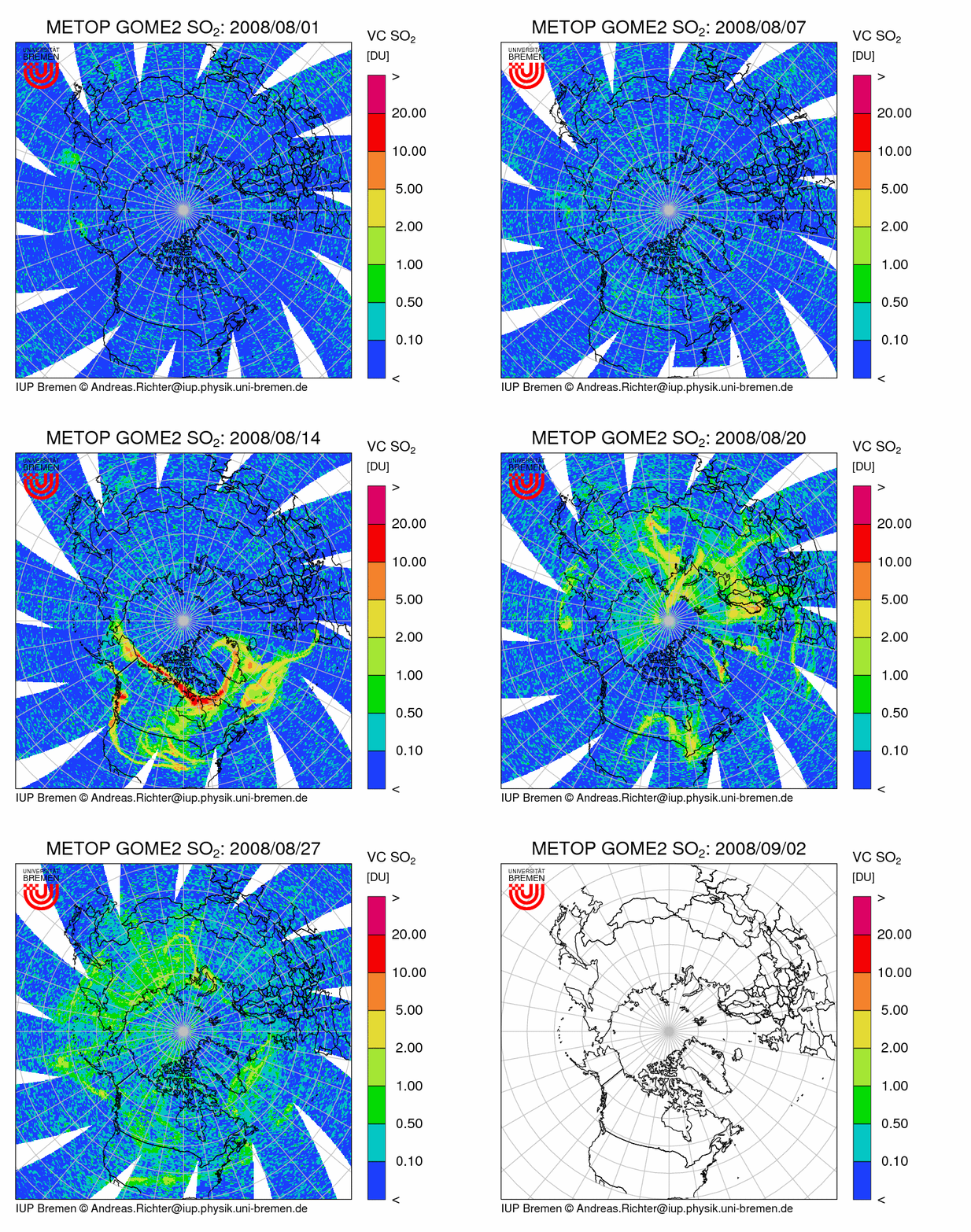
On August 7, the Kasatochi Volcano, situated on the Aleutian Islands near Alaska, erupted. Clouds of ashes and sulfur dioxide were ejected up to 15 km into the stratosphere.

During the following 3 weeks, the volcanic clouds spread over the whole northern hemisphere, causing widespread intense twilight colours and often also crepuscular rays. These were first reported from Northern America during mid August, but at the end of the month, these "volcanic twilights" were also observed in Europe.

In the evening of August 29, several observers reported a strange and intense yellow light around sunset, followed by a purple light. Some of them were reminded of the unusual twilights between February 17 and 20, which were caused by PSC.

On August 30, skies were clear over Germany, and so many observers could see a kind of silvery cloud stripes a few minutes before sunset. These stripes were orientated north-south and at first glance looked like cirrus or cirrostratus clouds. But during the day these clouds had not been visible at all, and when looking at them carefully, one could see that they were higher than normal high clouds. The contrails of some airplanes were obviously below these clouds, and as the contrails turned reddish in the light of the setting sun, the clouds still remained bright. So they must have been floating higher up in the air, somewhere in the
Stratosphere.

After sunset, the clouds got a more brownish-yellow hue, but turned pink only about 20 minutes after sunset. Some observers also reported intense crepuscular rays. The purple light faded about half an hour after sunset.

In the morning of August 31, the colours and cloud stripes could also been observed. In the evening, a cold front with thunderstorms approached the western parts of Germany. While even the tops of the cumulonimbus clouds were already dark, the stratospheric clouds still lay in plain sunlight. That evening, instead of the regular stripes of the day before, they looked more like irregular waves.

During the first days of September, the strange twilight colours could still be observed over southern Germany, while for the rest of the country morning and evening skies looked quite normal again.

But as there are still volcanic ashes in the stratosphere, the colours may return. So keep watching the skies before sunrise and after sunset.

Author: Peter Krämer, Bochum, Germany

Friday, August 22, 2008

Glass Bead Rainbow on Kitchen Table

The observation of a rainbow in glass beads on, respectively next to, a fresh route-indicator in a street I made by chance made me think about studying the effect also in the light of a street lamp. But unfortunately the glass beads had been scattered too much by the traffic within a few days. However, also by chance, I learned that glass beads are also used for facing the surfaces of, for example, metal objects, and so I asked our precision tool maker to bring me some...and then I started the experiment.

As a source of light I used a small bulb like those you find in a bicycle lamp, but without a reflector, because the light source should be as similar to a single point as possible. I scattered the glass beads on a black eloxated aluminum sheet (ca. 30 x 40 cm), and the result was overwhelming. Exactly as in the experiment made by Christian Fenn, the bow can be studied under different geometrical conditions when using a laser and a rotating mirror. The easiest way is to realize the reversed geometry just as otherwise the shadow of the head would be rather large as distances are small. Just put the metal sheet on a table, hold the lamp above it and look at it using different positions of your head. I also took some photographs after having attached the lamp to a mounting. This also shields the direct light. The first supernumerary is also visible, and like in the rainbow caused by water, a polarisation of light can also be proved. (1 2 3)

Seen through a microscope, the glass beads look like this:


I estimated the average radius to be at about 50 micrometers with an average variation of about 15 micrometers. But there are different sizes available. Similar to water drops of that size, the colours are rather blurred (this is especially obvious when you look at a glass bow in sunlight). The spectrum of light coming from a bulb is also rather "red" which causes the strange colours of the pictures.

As I was very fascinated by that phenomenon, I also calculated some simulations using the Airy-theory for glass beads (I could reuse some parts of the original text about the twinned bow for this). And in order to show the phenomenon from the observer´s position, I could use the text on halos on snow covers (so after 10 years the circle is closed...). An imaginary depiction seen from above obviously shows the "intersection through the apple", but as far as I know, nobody tried to explain the different width of the colour bands up to now. Tis effect becomes very obvious when "opening the inner bow by merging with the outer one" (This is very difficult to describe; you must have seen it). However, the geometrical data of the simulation are not exactly the same as in my observation because I did not execute any measurements while photographing.

Left: Seen from above with the observer´s position in the centre of the picture
Right: Gnomonical projection from the observer´s position (“simulated photograph”)

Author: Alexander Haußmann, Hörlitz, Germany

Tuesday, August 19, 2008

Yellow Rainshower

On August 13, I could witness another atmospheric phenomenon in Bochum, Germany.

In the evening, about half an hour before sunset, a rainshower approached from the west. Behind the shower, the sky cleared up very rapidly, so that the low evening sun could shine through the veil of rain. This caused very strange light conditions I never experienced before.

First there was a yellow squall line visible, followed by a bright yellow veil of precipitation. As it came nearer, another shelfcloud-like structure passed from south to east. This cloud was also strangely illuminated and showed orange and brownish colours.

The squall line in the western and northwestern part of the sky turned more and more orange, too, while the rain got an intense and bright yellow. The whole landscape was bathing in a strange and intense yellow light with orange-coloured clouds above and in the east.

When it began to rain, a rainbow appeared in the east, visible as a full semi-circle. The blue part of the bow had already gone, only red, yellow and a faint green were visible.

Then the sun sank beneath the horizon, and all colours faded away within a few minutes. So there was no really red rainbow that evening, but nevertheless it had been very impressive to me.

Author: Peter Krämer, Bochum, Germany

Twinned Rainbow

On August 13, after a rainshower had passed over Bochum, Germany, a twinned rainbow appeared. The bow was rather faint, but the twinning in its upper part was clearly visible. The red and the yellow colour bands of the rainbow were twinned.

On photographs of the rainbow, the twinning effect is hardly visible, but after oversaturating one of the pictures, the twinning turned out well.

During the rainshower, large drops were falling. A second shower about half an hour later with normal-sized drops also produced a rainbow. Even though this bow was very bright, it was not twinned, but showed a secondary bow and supernumeraries.

This is another hint for the theory to be right that the effect of twinned rainbows is really produced by large raindrops getting flattened by the resistance of the air when falling.

Author: Peter Krämer, Bochum, Germany

Friday, August 15, 2008

Light refraction on Fireweed-seeds

While testing my new Tamron AFR70/300 on several plants and flowers I passed a very steep slope overgrown with fireweeds.The sun was relatively low above the slope that I noticed a silky lustre beetween the seeds. As more I was moving the plants beewenn me and the sun, the effect merged into an incredible refraction of light on the silky like seeds. I shot a few pictures and those which where slighty off focus showed very bright colours. This effect seems to be similar with light refraction on spider-webs. In this case though colous where extremely bright.

More pictures: 1 2 3 4 5

Author: Rolf Kohl, Germany

Saturday, August 02, 2008

Summer twilight rays

Bright twilight rays on 16 July, 2008 in Green Bay, Wisconsin. They stretched nearly all the way across the peaceful evening sky. This photo was taken 20 minutes after sunset. I enjoyed the view from our front deck for about 10 more minutes.

Monday, June 09, 2008

African dust over Europe

In the last days of May there was an expansive dust layer above central Europe that caused a lot of interesting atmospheric phenomena. The story begun on 27th of May, when an ochre colored aureole surrounded the sun, and the sunset was pale yellow what repeated the next morning. There was a 7-8 degrees wide, dark greyish band by the horizon (image by Ágnes Kiricsi, in Vecsés, Hungary) this made the dawn to be late and the sunset to be too early. On the next days Bishop’s ring was observed through Central Europe – in the Czech Republic, in certain parts of Germany, and in Hungary. (This Bishop’s ring looks the same as it was produced by volcanic particles.)

In the Alps the dust strongly reduced the transparency of air (to about 3-4 kms).
The photo was taken by Bertram Radelow in Davos, Switzerland. The situaution was the same in the northern and eastern parts of the Alps.


The last two days of May passed away with the attenuation of the dust layer, dust fell out – both dry and wet way. At my hometown the dry version occured and a thin layer of fine yellowish powder subsided on the plants and the parking cars. In Germany there was a reddish-ochre coloured muddy rain falling that caught attention. The same thing happened at some places in Hungary too where rainshowers washed out the dust leaving muddy traces on everything.


In the meanwhile the dust „cloud” could even reach southern Scandinavia, where it also produced „colorless” sunset. The photo was taken by Andras Uhrin in Stavanger, Norway.


The origin of the dust is in the deserts of Africa. Late spring and early summer there are proper conditions in the Sahara and Sahel region for the fine dust to lift up high in the atmosphere where hot, dry winds transport it towards Central Europe, causing the same phenomena almost each year. There were „blood rains” in Europe caused by this Saharan dust over the centuries, like the ’Blutregen’ in 1901 in Germany, when the dust mass that fell out was 1-4 grams / square meter! The micron sized particles are mixed of fine sand and fine mica pellets.

Tuesday, May 06, 2008

Rainbows and supernumeraries

During last weekend (Sunday 4th May -08) at city of Espoo, I observed seasons first rainbow. Local thunderstorm came along with rainshowers produring primary and secondary bows. I visually saw 3 primary supernumeraries.

In the heavily enhanced image (USM) of primary bow there is small hint of 4th supernumerary visible (1). Outside of seconday bow (2) there is larger arc (dark pink color), assuming it indicates supernumerary also... The droplet sizes may been quite even, due to easily visible interference bows.

Thursday, May 01, 2008

Heiligenschein and dewbow in moon light

Well, I wanted to observe moon halos that evening, but the sky was totally clear without any cirrus clouds.
I noticed that some blades of the plants on a field were rather wet. I walked some steps into the field and immediately noticed a clear brightening around the shadow of my head. I did a few steps to the left and to the right and could see a very faint dew bow. So I took some photographs at different exposure times and ISOs. The best photographs (1 2) I achieved using stop 4, an 18-mm-lens and at a time of exposure of 45 seconds at ISO 400.

Author: Michael Großmann, Kämpfelbach, Germany

Thursday, April 03, 2008

Polarization Colours in Airplane Window

Patrice Touhar took this photograph through the window of an airplane using a polarization filter and so made these polarization colours appear.

The colours are generated by the combination of three circumstances:
  1. There is polarized light behind the window
  2. The window is made of a double refracting matter
  3. A polarization filter is used in front of the window

Under these circumstances, the light gets split up into two coherences of polarized components which travel through the window at different speeds. This causes a phase difference the amount of which depends from the wavelength. This means that the polarization gets transformed once into a linear polarization of a different direction than the origin for a certain colour, and into a circular polarization for another colour (Lissagiu interference of two waves). As the polarization is now dependent from the colour, the colours appear when a polarization filter is used, no matter if this filter is placed in front of the eye or in front of a camera.

These colours can be seen and photographed under the following circumstances:

  1. There is polarized on one side of the window coming from the blue sky (Rayleigh scattering) and reflection from water and the scattering caused by clouds
  2. The window is made of plastic. In this material there are mechanical tensions which cause a double refraction.
  3. There is a polarization filter in front of the camera.

The last condition is not necessary if you look at the window from an acute angle. Then the light becomes already polarized by the refraction. In this case there is no filter necessary to see the colours. However, the colours you can see under this circumstance are fainter than the colours seen through the polarization filter because refraction polarizes only a part of the light.

You can also find another observation of this kind in this former thread.