Saturday, January 26, 2008

Icy window corona

At the beginning of this winter season at a cold morning - dark outside - with a thin layer of hoarfrost on the inner side of the bus windows I've noticed that the light of the street lamps' light was not simply scattered on the windows, but having colorful corona around them. At that time I had no camera with me… All along the winter I was waiting for the same display each morning when some ice was on the bus windows, but for long weeks I haven't met with such spectacular phenomena again.This day was my day on 24th January. Very thin layer of frost was on the inner part of the windows, (with some frost ferns too by the corner of the window frame), mainly this layer was made of small uniform ice crystals made of frozen vapor droplets, we might call it an ice film, it was about 0,1 mm thin.All the lamps outside had a corona, no matter how far the lamp was.The street lamps with white light had the most beautiful color range, the orange colored light of sodium vapor lamps had a less distinct colors and they were a bit moved towards the reds. Not only the street lamps' corona was seen on the ice layer, but a much less spectacular corona around the reflection of the inner lamps of the bus too! At the part of the frost ferns pattern the corona became irregular in shape. When the lamp was near the window I could also see the bigger outer rings of the corona. Almost the same phenomena appears when simple water vapour is on the windows, but that one is really less poor in colors compared to the ice film corona.This was the first time when I could take photos of a corona produced by ice crystals. It's a pity, I could not take close-up photo of the ice layer itself (the bus was driving me to work so it was permanently moving).

Photos are collected here: The only afterwork was some noise reduction and size reduction. It was totally dark outside, so the pics were taken with ISO200 - ISO400; aperture F4 - F5,6; exp. 1/15 - 1/25 sec. auto white balance; without tripod or any kind of help to avoid moving.I wonder if the same phenomena would appear if the outer side of the windows would have a layer of hoarfrost on it. It's only weather's turn to show it up!

Author: Monika Landy-Gyebnar, Veszprem, Hungary

Thursday, January 10, 2008

"Subsun" upon ice crystal

While taking the photographs of the iridescent fissures in the ice, I noticed some beautiful ice crystal structures on one of the puddles. When I looked at them more closely, I saw intensive reflections of the sun in them. Animated by the hoar-frost halo I discovered before, I got the idea to photograph the reflection of the sun as a kind of “subsun”. To get the reflection completely into the picture, it was necessary to make a macro of the ice crystal. However, the crystal turned out ot be a lot more complex than I thought.

The reflection of the sun, however, was not a homogenuous surface, but appeared to be a slightly oval shaped, speckled white spot with a broad golden and also speckled rim. It is exactly this reddish-golden rim that gives me quite a headache, reminding me a lot of the reddish coloured fringes which sometimes can be seen at other haloes like parhelic circle or 120°-sundogs. The sequence of colours and the outward manifestation is that of a common aureole. However, in this picture it looks as if the colour came out of the inside of the ice crystals. Especially take a close look at the crystals marked with arrows.

About one week later at another frozen puddle, the reflection of the sun again had a reddish rim. But here the situation is quite different. This time it is a fragment of the frozen water surface. The wind has carried dust upon the ice which with the help of the sun had smolten innumerable tiny holes into the surface which originally had been smooth. Low temperatures then had made it freeze again. All in all, these processes have caused a rather permeable surface structure to develop, so the reflection of the sun is more like a diffraction. Especially in its upper part, there is an indication of iridescence. Who knows, on day somebody might succeed in taking photographs of “ice surface coronae”!

Last but not least: Of course you can also try to take a fragment of ice off a puddle and make some experiments with it. Maybe there will be confirmations of these sightings pointing also out to the possibility of a (additional) light refraction in the red rim.

Author: Reinhard Nitze, Barsinghausen, Germany

Monday, December 31, 2007

Silver Fir Diffraction

The photo here was taken by Mónika Landy-Gyebnár. It shows light through the branches of a silver fir with thick, short grown needles. The camera was looking towards the sun and out of focus - just like in the spider web post of September. The curved structure is caused by diffraction. The image shows well-visible colours, and what makes the photo even more interesting is the horizontal lines across these coloured bands. Could it be some interference pattern created by the less spectacular slanting stripes on the side of the image? Or something else? More pictures

Saturday, December 29, 2007

Shadow Rays above Pithead Rig

In the morning of December 21, 2007, a beam of shadow rays appeared above the pithead rig of the German Minery Museum in Bochum, Germany.

The picture was taken at about 10 a.m., one hour after sunrise. As the sun elevation was still very low, the shadow of the pithead rig was projected upwards and became visible as a beam of shadow rays in a thin layer of mist near the ground. A similar phenomenon can sometimes be seen above a pylon or tower, but there only one single dark ray appears. The shape of the pithead rig, however, made a beam of four shadow rays appear.

Author: Peter Krämer, Bochum, Germany

Colours on fissures in ice

In the late afternoon of December 15, 2007, temperatures began to stay below freezing 24 hours a day for the first time (!) in this year. Already the next morning, many of the small puddles on a lane near our town Barsinghausen were covered with ice. Children enjoyed breaking these crusts of ice with their feet. But at some of the puddles which had frozen down to the ground, they had no success and just caused some fissures in the ice. These fissures showed extremely intense colours.

The colours are probably caused by interference. Light enters the ice and is reflected to and fro between the edges of the fissures. So there are differences in the time the light needs to cover the distance between the ice and the eye of the observer. This causes light waves to amplify or extinguish each other. This is what we perceive as colours.

There is no direct sunlight necessary for this effect (1 2), but it can increase it enormeously (3 4).

Author: Reinhard Nitze, Barsinghausen, Germany

Wednesday, November 28, 2007

St. Elmo's fire in Switzerland

On Nov/14/2007 between 18:00 and 19:00 CET St. Elmo's fire appeared on a tower at the summit of Mt. Gäbris in Switzerland. The phenomenon was captured with a high sensitive video camera operated by Mark Vornhusen of Meteomedia, a private weather company.

There is a 25m metallic tower located on the summit of Mt. Gäbris (1241m). Three webcams are fixed on top of the tower, looking in different directions. One of these cameras shows a part of the tower, a metallic extension arm, in the outermost right corner of the image. St. Elmos's fire became visible at this extension arm.


The St. Elmo's fire developed during a snow thunderstorm. Only one lightning strike occurred during this storm. The strike is visible on the webcam images at 18:55 CET as a sudden flare of the image and was heard by the author, who lives 2km away from the summit. The lightning strike was not close to the tower, because the flare was not very bright. The cameras operate with a special software that is able to capture all bright objects on the night sky, even if the duration is only a fraction of a second (lightning, meteors).


The St. Elmo's fire was first visible on the webcam images at 18:05 CET and lasted about two minutes. The second and most intense appearance occurred between 18:40 and 18:50 CET, followed by the lightning strike at 18:55. During the 10 minute interval between 18:40 and 18:50 CET the weather station, which is also located on top of the tower, measured a wind gust of 75 m/s (270 km/h). This is obviously not a real wind speed. More likely it is an interference of the high voltage and the St. Elmo's fire to the anemometer. The ultrasonic anemometer uses sound speed to measure the wind speed ( http://thiesclima.de/usanemo.htm ).

To the authors knowledge it seems to be the first time ever St. Elmo's fire was imaged, at least a "classic" one that occurred on the ground and not during a flight on an airplane.

Monday, November 26, 2007

Animal Optics

In this blog we have already seen photos of spiderwebs scattering rays of light, and even a thistle seed showing spectral colours. Now I would like to contribute to this collection with another possible source for observing this optical phenomenon: cat's hair. The pictures attached show the dark Sámán (of Mónika Landy-Gyebnár) and the white Manci (my cat). When light comes from the appropriate angle, their fur can display the colours of the rainbow surprisingly clearly. Please, click the images to see it better. Full size photos of Sámán's and Manci's shining hair are also available.

The other photo is another "animal test". Given that birds' feathers have a very regular structure, I was interested whether they show corona-like diffraction if we place one in front of a light source. I found that the repetitive structure of barbs, barbules and tiny hooks interlocking on them create beautiful interference patterns. This picture - somewhat out of focus - shows an owl's feather (a secondary from its wing) with a lamp behind it. The pattern is curved because the feather itself has a bent surface. Further images: #1, #2, #3

Thursday, November 22, 2007

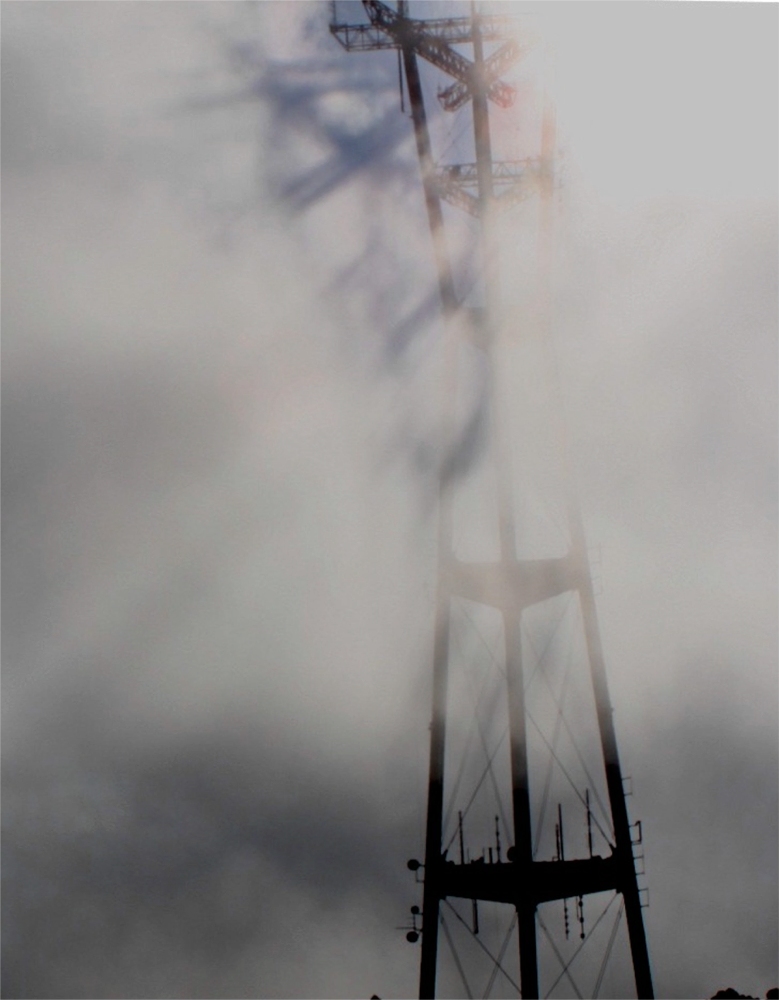
Fog shadow of TV tower in San Francisco

Fog shadow of Sutro tower, San Francisco. These fascinating shadows look odd since humans are not used to seeing shadows in three dimensions. The thin fog was just dense enough to be illuminated by the light that passed through the gaps in a structure or in a tree. As a result, the path of an object shadow through the "fog" appears darkened. In a sense, these shadow lanes are similar to crepuscular rays, which are caused by cloud shadows, but here, they're caused by an object shadows.

Tuesday, November 20, 2007

A strange kind of glory

I have often seen glories which appeared to be elliptical (and not circular) or vertically disrupted. This was always caused by the projection onto an uneven cloud cover. But on November 18, 2007, I could observe a "vaulted" glory from Mt Wendelstein (1835m) in the Bavarian Alps. The strange glory appeared in an isolated stratocumulus cloud which adapted to the shape of a mountain. Its colours ended irregularly on its outer fringe like those of a glory around the sun which pass over to cloud iridescence. There is no circular shape recognizable in the colours outside the inner glory rings. The pictures are taken using a polarization filter and the contrast has been increased.

Another observation which might be related to mine, has been made on January 01, 2007 by Stefan Rubach on Mt Großer Arber.

Sunday, November 18, 2007

Perspectively broken shadow

When there are swelling cloud parts on the surface of an unbroken cloud cover, it sometimes can happen that the shadow of a pole projected onto this cloud cover appears kind of broken. I could observe such a shadow broken perspectively on August 18, 2007, at 18.15 hours CET on the top of Mt. Wendelstein (1835m), when the shadow of the transmitting aerial of the Bavaria Broadcast fell upon such a cloud cover, surrounded by a glory which appeared three-dimensional.