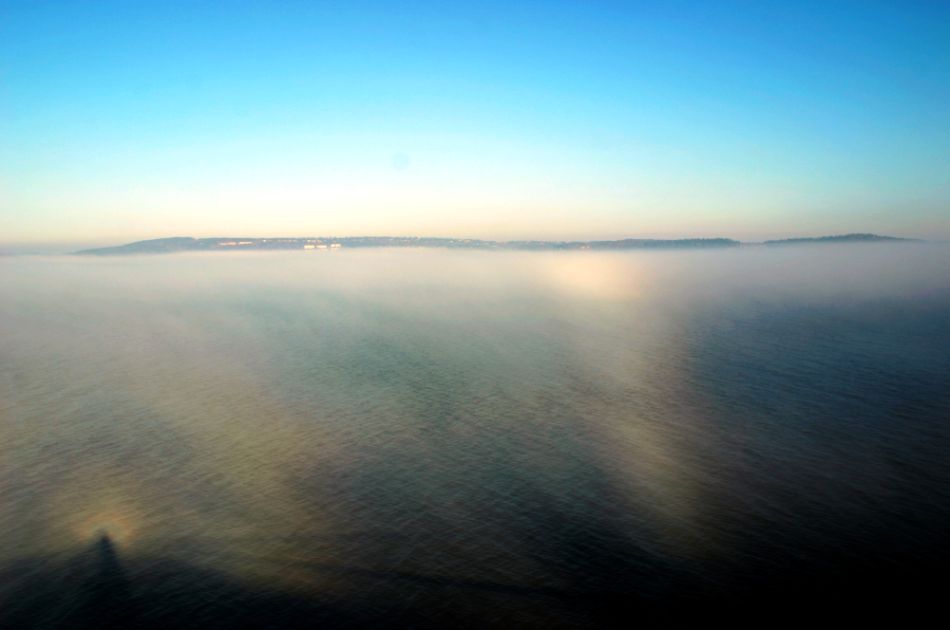
 On March 24th 2005, Thorsten Gaulke was sailing homeward bound from Oslo to Kiel on a scarcely four month old ship called "Color Fantasy". The ship entered an area of sea fog no higher than the ship formed by the cooling effect of the cold Baltic waters. With the sun to his back he was able to observe his Brocken Spectre surrounded by a bright glory. There is a trace of a much large glory-like phenomenon that might have resulted from much smaller droplets. Alternatively it could be a fragment of an inner supernumerary of the surrounding fogbow.
Sunday, August 13, 2006
Brocken Spectre in sea fog
On March 24th 2005, Thorsten Gaulke was sailing homeward bound from Oslo to Kiel on a scarcely four month old ship called "Color Fantasy". The ship entered an area of sea fog no higher than the ship formed by the cooling effect of the cold Baltic waters. With the sun to his back he was able to observe his Brocken Spectre surrounded by a bright glory. There is a trace of a much large glory-like phenomenon that might have resulted from much smaller droplets. Alternatively it could be a fragment of an inner supernumerary of the surrounding fogbow.


Saturday, July 08, 2006
Icebow?
 Claudia Hinz observed a strange ‘rainbow’ on 5 May 2005 from Mt. Wendelstein (alt. 1835m). During a strong ice pellet shower from collapsing cumulonimbus there appeared an almost 20° long faint, but coloured piece of bow. It was rather diffuse, ragged and very broad. The sketch shows the bow. The sun was 50° high and the bow was approx 8° below the horizon.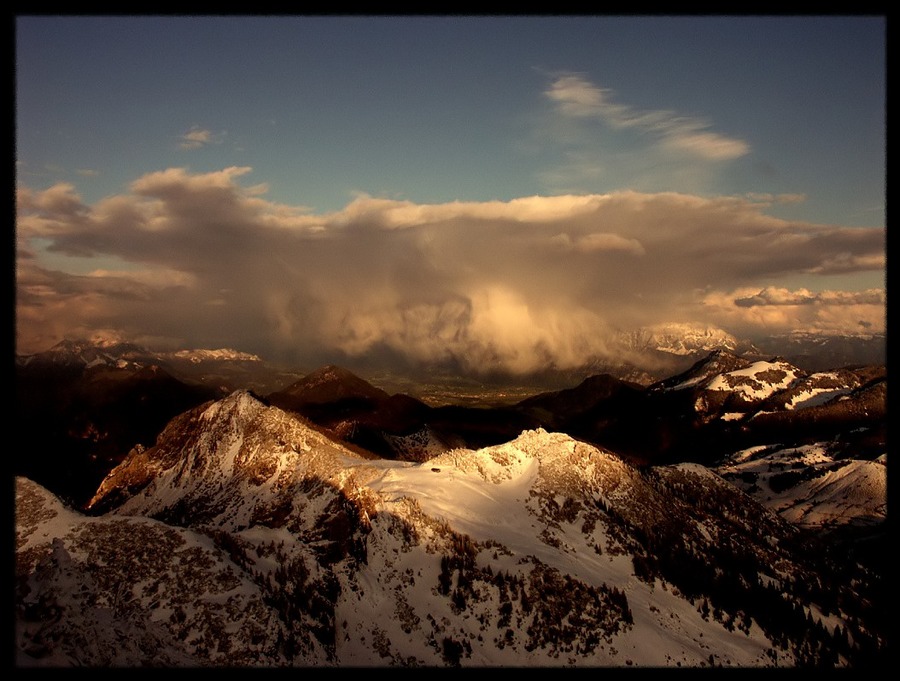

From meteorological experience, a dying cumulonimbus can only produce ice when it collapses from the top and in the lower levels the temperature is low enough that the ice does not melt. That was the case here, the cloud collapsed and decayed fully into graupel. There was definitely no rain, which I had also not experienced previously with a ice pellet showers.
I do not want to commit myself whether there can be an ice pellet bow. However, the ice grains may occasionally be covered with a water layer, giving a smooth outer surface. Of course, the refraction in the ice-water interface must also be considered. If that interface was uneven it could explain some of the bow width.
On 11th of January 2006 Christian Fenn reported crystal-clear ice balls (photo 1, 2), in sleet falling at an air temperature of -4°C. He searched for an ice bow formed from the headlights of his car. In this picture the possible ice bow is compared to a (terrestrial) rainbow. There are also images by Christan Fenn of the ice balls.


Friday, June 23, 2006
Pine pollen corona in Finland
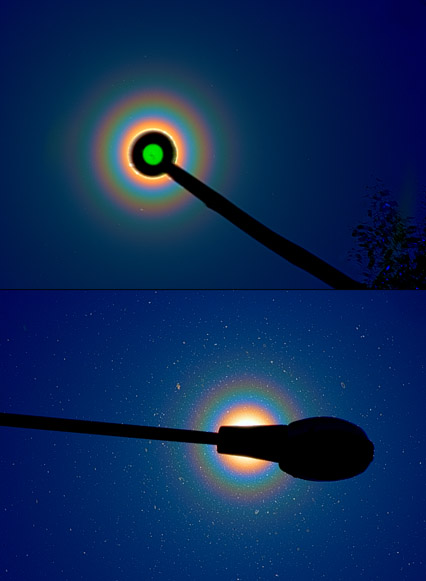 Continuing on the favorite topic of pollen coronas, here are two rather painstakenly constructed images of pine pollen corona.
The white dots are wind dispersing seeds, probably of some willow species. They are more abundant in the lower image, which was taken in town. The upper image was shot in the midst of pine heath, with correspondingly less white fluffs in the air.
On 13. June 2006 in Eastern Finland. Larger sized versions are here.
Thursday, June 22, 2006
Miraged Ships
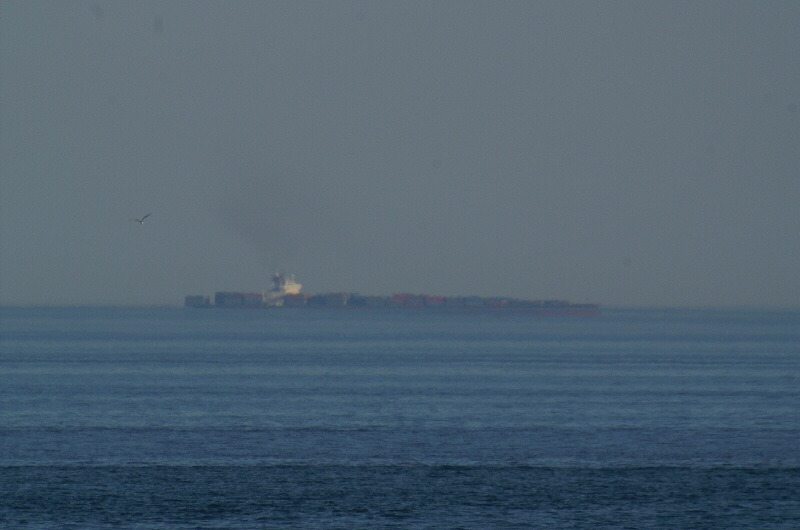 On June 11, 2006, Thorsten Falke and his girlfriend Bärbel Wichmann decided to have a picnic at the south-beach of Düne, a one square kilometer little island in the North Sea and in the neighbourhood of Heligoland.
Even though the picnic basket contained several tasty titbits the sky was even more tempting with its unusual mirages. Ships passing Heligoland and Düne at a distance of 10 km or more appeared somehow "stretched". They looked longer than they really were.
 Thorsten and Bärbel are still wondering how this effect come about. The sun was shining the whole day and because there was almost no wind, a warm air layer probably lay above the water surface. They suggest that when a ship is on a course of 45° (for example) towards or away from the observer, the bow of the ship is closer/further to the observer than the stern. This, combined with the warm air layer, may cause the unusual extension/or sometimes shortening of the ship.
The two images are 15s apart. More mirage images here.
[Text: Thorsten Falke & Bärbel Wichmann]
Tuesday, June 20, 2006
Pollen corona during solar eclipse
 A pollen corona was seen by several observers at the Southern coast of Turkey during the total solar eclipse of 29th March 2006. This nice picture taken by Emma Herranen shows the atmospheric pollen corona with three colour segments only a few seconds before the second contact, as illuminated by the diamond ring phenomenon. The inner parts of the solar corona are seen as a white circle around the Moon.
Thursday, June 15, 2006
Colourful refraction by the surface waves
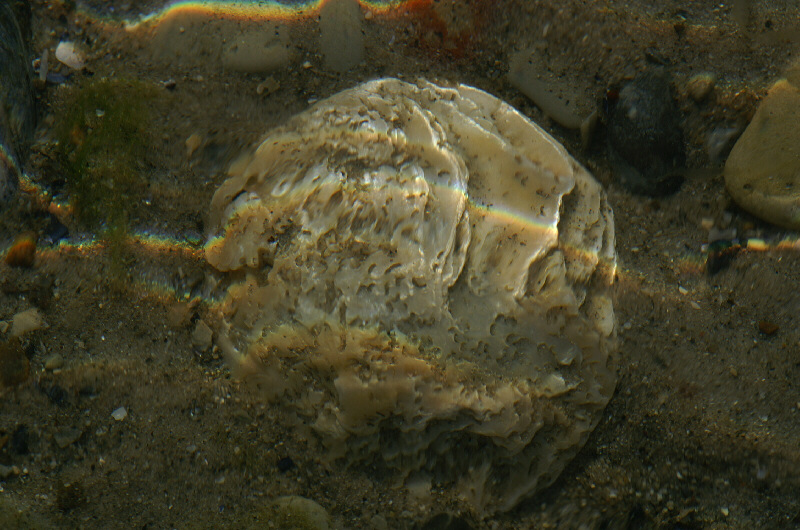 On June 13th Thorsten Falke from the German North Sea isle "Düne" (near of isle "Helgoland") was walking along the seashore, when he saw criss-cross light structures on the seabed obviously caused by refraction by the surface waves. He had seen the phenomena often before but this time it seemed to be coloured. He decided to paddle out into the water to take pictures. It was difficult to see the colours visually because of the rapid movement of the little waves (only 2 cm "high") but in many of the pictures the colours were evident. The appended picture was taken with a macro lens and shows a shell in 10 cm deep water with a colourful refraction band across it. Because of the macro lens the picture is nearly 2 times life size. Another refraction is located at the upper edge of the picture. If he remembers rightly, the light was coming from the left side and was parallel to the wave crests. The main interest of Thorsten is to observe whether the colourful refraction is seen only when the wave crests are parallel to the light direction or if it is also visible when the crests are at right angles to the sunlight.
Saturday, June 03, 2006
Subhorizon rainbow
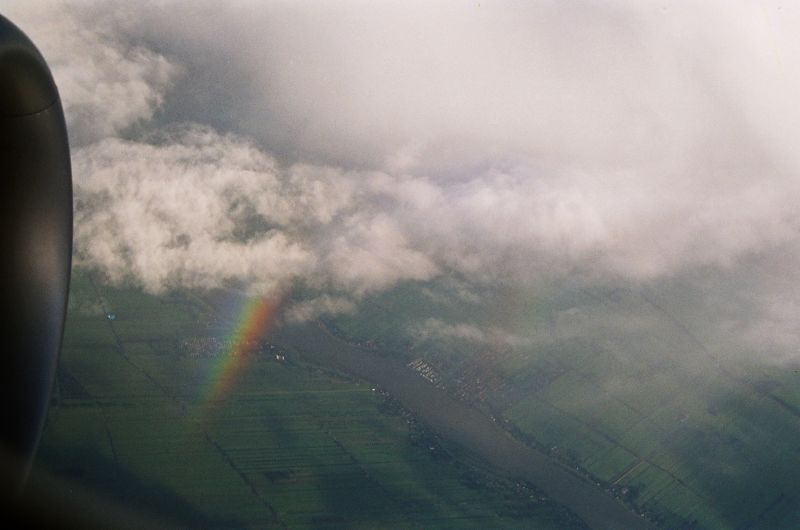 This deep-subhorizon part of a rainbow was photographed by Günther Können on 2 Oct 2005 on a flight from Amsterdam to Madrid. Although cloudbows are frequently seen from an airliner, rainbow sightings are relatively rare. To my (Günther's) experience, the best chances are when the altitude of the plane is not too high. It was the second time that I saw such a distinct one, the first time being 23 yr ago.
Tuesday, May 30, 2006
Spider web reflections
 In Germany October 2005 was very dry, calm and warm with no frosts. The weather gave rise to a large number of spiders and of course their webs. Towards the end of the month, Reinhard Nitze’s attention was drawn to an unusual light phenomenon on a ploughed field. The sun produced a silvery reflection like the glitter path seen on waves when the sun is low. He had seen the effect earlier on scythed grain and grass fields but never so conspicuous. The effects were produced by sunlight reflecting off threads of spider silk that happened to be perpendicular to the sun – eye line in the numerous webs in the fields (more images 1,2,3).
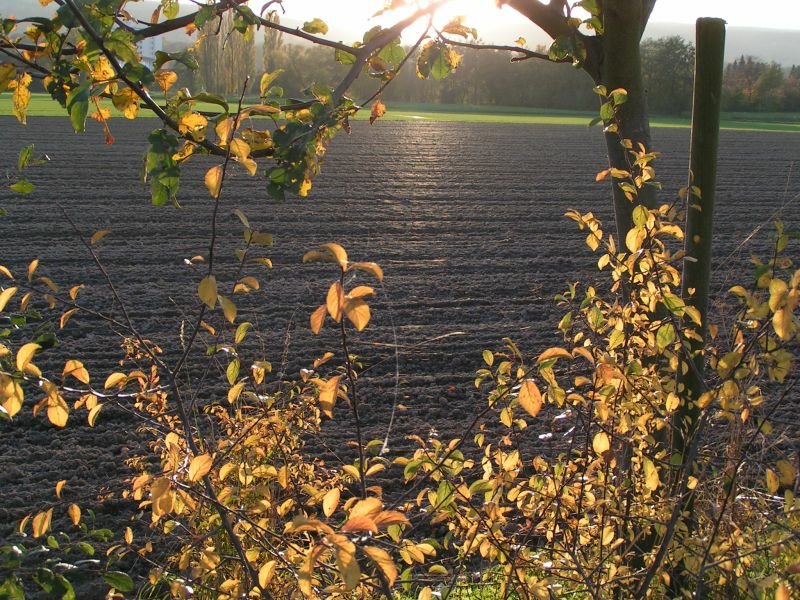
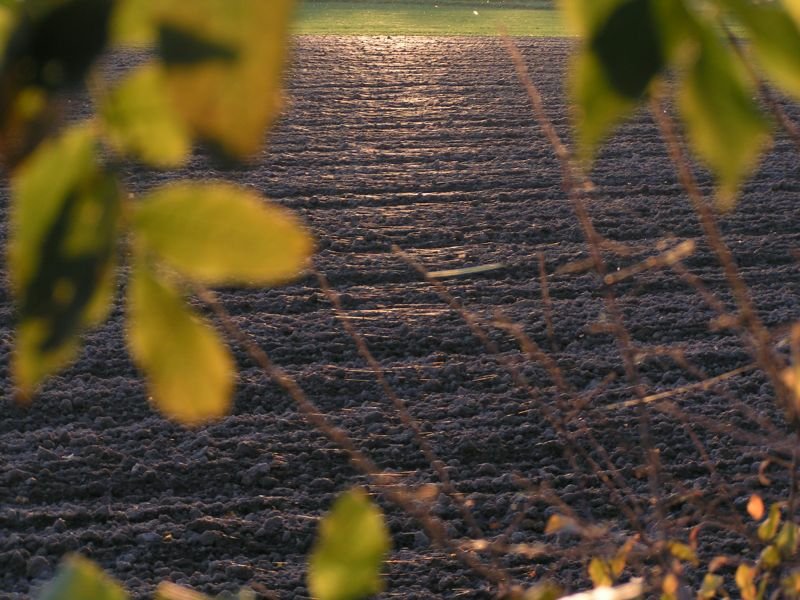
 The effect is seen also in the lower left image where the web reflections in trees make concentric rings.
Bare and wet twigs produce similar effects as do support wires in vineyards. Perhaps observers have seen other reflection effects like these?
[Report: Reinhard Nitze]
Wednesday, May 24, 2006
Unusual Coronae & Sunsets - Finland
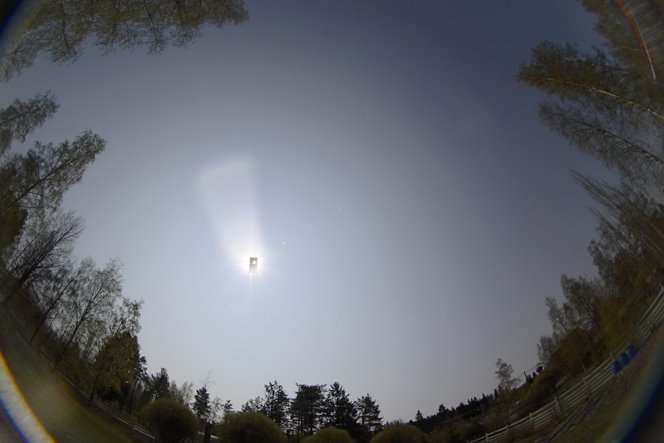 Very large coronae were observed in Southern Finland at the beginning of May 2006. Their radius was about 45° and they had a bluish disk and a brown ring. The sky was very clear and quite dark outside the corona. Also, very beautiful red sunsets were seen on those days.
The phenomena were visible on many days between May 2-11 and were possibly produced by smoke carried from Eastern Europe.
In the above corona image taken on 11th May a small segment of another photo has been added to show the size of 22° halo for comparison.
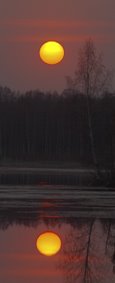 The sunset was photographed on 4th May.
Large coronae can be seen during very warm weather periods when the sky is usually hazy. This was the first large corona seen in Finland since the Bishop’s rings of 1991-1992. Smaller coronae (radius of about 5°) with a blue disk and brown ring have sometimes been observed.
[Text & Report: Jari Piikki, Juva Finland]
Monday, May 22, 2006
Fogbow with supernumeraries and Glory
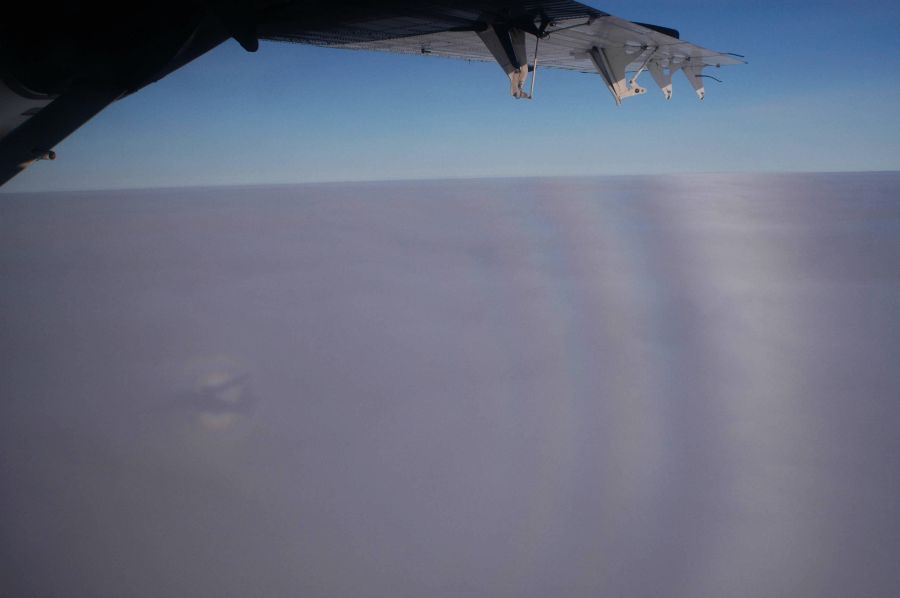 This fogbow and glory was photographed by Ken Tape on May 12, 2006 while descending to a place called "Isachsen" located at 79 degrees North in the Canadian archipelago. The display and descent lasted for about 10 minutes, and the strength of the bows was fairly constant throughout. The intensity of the fogbow supernumeraries was strengthened by the use of a polarization filter. Note that the color sequence in the supernumeraries – blue outside – is reversed compared to that in the main maximum. The shadow in the glory is of a Twin Otter on skis. Nikon D70 with old 20mm lens (effective 30mm).
[Text: Ken Tape, edited by Günther Können]
Subscribe to:
Posts (Atom)