Wednesday, August 19, 2009

Intense colours of a lightrefraction on fireweed seeds


This year the season of my firweed-hunt began earlier than last year because in hope of a better lightrefraction on early seeds. It was about mid-july when I saw the first seeds falling and I was very surprised when i moved the seeds beetween the sun and my camera. The effect was extremely strong. I guess this came from the fresh seeds, they were not sticked together like last year and showed real bright colours. I shot about 20 pictures and afterwards I went alomost crazy when I saw these intense clours on my PC. The pictures (1-2-3-4-5-6-7-8) were taken with a Canon EOS 350D and a Tamron AF 70-300mm Makro lense near Langgoens in Germany.

Author: Rolf Kohl, Langgöns, Germany

Tuesday, August 11, 2009

Reflected light dewbow on water surface

I and my wife Eliisa Piikki got a hint about a light phenomenon on a lake nearby. Eliisa took some photos and there was a dewbow and a reflected light dewbow in those photos. They were formed on the waterdroplets that were settled down on the Chrysomyxa ledi needle rust (Small-spored spruce-Labrador-tea rust).

That rust can't be seen in Finland every year, but this year it is very common especially in the Eastern and in the Northern Finland. Because of the rust the young needles of some spruces are brown.

Author: Jari Piiki, Finland

Friday, August 07, 2009

Reflection rainbow (Lahti, Finland)

On the evening 5th of August 2009, there was a reflection bow observed at city of Lahti. Marja Wallin saw and photographed a small fragment of reflection primary bow.
For the moment, the precise location of sun ray reflection is not yet analysed... To see her other rainbow photos for same evening, look at here.

Update (11th Aug 2009):
There is another gallery existing of the reflection rainbow, in same date and location, taken by Sami Luoma-Pukkila.

image (c) Marja Wallin

Tuesday, July 21, 2009

Volcanic Twilights

On June 12, 2009, one of the most active volcanoes of the Kuril islands near Kamtschatka, which is situated near the northwestern end of the island of Matua, Sarychev Peak, erupted.

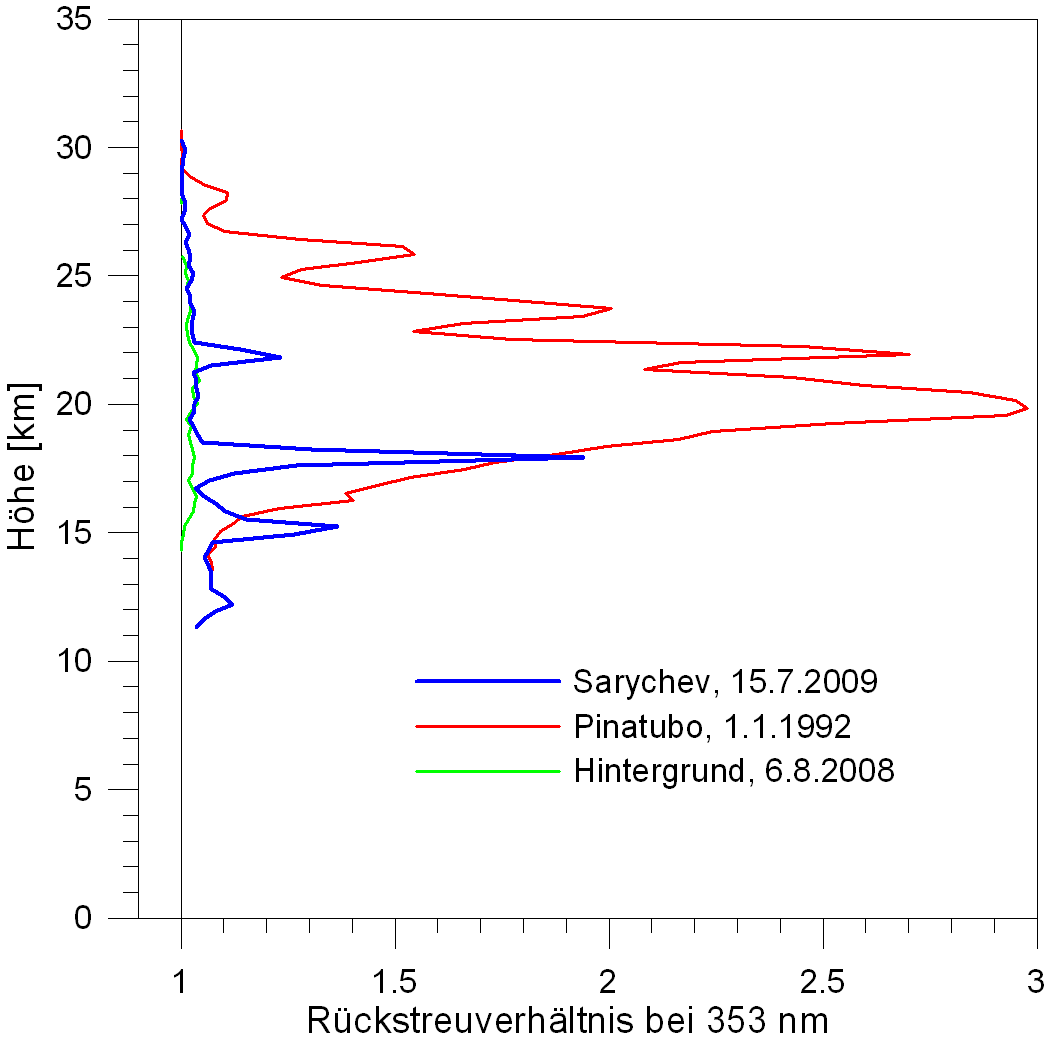
A NASA picture taken from the ISS gives an impressive sight of the eruption. Ashes have been ejected up to 20 kms into the atmosphere. Only a few hours after the eruption, the sulfur dioxide cloud of the volcano covered an area of 2.407 kms in width and 926 kms in length above the island. During the following weeks, the aerosoles spread over the whole northern hemisphere.

Since the end of June, also in Central Europe unusual twilights are observed. The up-to-date Lidar measurement from the Hohenpeissenberg observatory in Bavaria shows three aerosol layers in altitudes of 15, 18 and 22 kms in comparison to the eruption of Mt. Pinatubo. It is very interesting that the layers in 15 and 18 kms have come here with westerly winds passing over Alaska, Canada and the Atlantic Ocean, while the layer in 22 kms has been transported to us by stratospheric easterly winds passing over Asia (Russia/China). So the volcanic aerosoles have travelled around half of the planet in two different directions (the lower layers eastward and the upper one westward), meeting again here over Europe. I think this is worth to be mentioned.

On July 4, Peter Krämer observed the caracteristic crepuscular rays (picture above). On July 13, Reinhard Nitze photographed the most spectacular volcanic twilight in Barsinghausen near Hanover (Fig. 3
). In his picture, the high aerosol clouds can easily be recognized. These clouds still receive sunlight while normal cirrus clouds are already within the shadow of the earth.


During the past few days, there were also noctilucent clouds visible, which passed over to the reddish aerosol clouds in lower layers. There should be unusual twilights visible also during the following weeks.


Saturday, July 04, 2009

COMPOUND EYE OF A HORSEFLY

July 11, 2008:

I was very astonished when I was working and suddenly a horsefly fell upon my workbench.
The animal was about 3.5 cms in length. It was a very hot day, and the “flying fellow” had obviously lost his way, landed up in the workshop and could not find the way out. Well, the animal was lying there without moving, and the sunlight caused nice diffraction colours in its big compound eyes.

Author: Michael Großmann, Kämpfelbach, Germany

MONASTIR RED RAINBOW

On May 13, 2008, I was flying to Tunisia. Just before the plane landed in Monastir, I looked out of the window and saw a faint onset of a red rainbow. About one minute later, the rain became heavier, and the bow became more intensive, even below the horizon. Unfortunately, the plane landed about two minutes later, and I could not see if the red rainbow was visible from the ground.

Author: Michael Großmann, Kämpfelbach, Germany

BACKLIGHTED WATER VAPOUR

March 10, 2009:

There is not always fine weather outside for making pretty pictures. So I tried to take some photographs of backlighted hot water vapour. Surprisingly, some pretty irisation colours appeared, which kept constantly changing in the rising “fountains”. Even after a short time, as the water cools down, the colours become less intensive as they are when the water is very hot.

Author: Michael Großmann
, Kämpfelbach, Germany

Saturday, June 13, 2009

Bochum Twinned Rainbow

On June 9, 2009, another twinned rainbow appeared in the skies over Bochum, Germany. The phenomenon only lasted less than a minute, and I could watch the “twin ettect” move from left to right through the rainbow.

This picture has been processed to make the effect more obvious, but here is another picture showing how it really looked (1).


Just after the “twin effect” had disappeared, the rainbow reached a stunning brightness making supernumeraries visible as well as Alexander´s Band (2).

Text: Peter Krämer, Bochum, Germany

Tuesday, April 21, 2009

Pollen corona in Deventer, The Netherlands

On April 1st 2009, Peter Paul Hattinga Verschure observed beautiful pollen coronae from his garden in Deventer, The Netherlands. Every time the wind blew through the pine trees, a cloud of pollen was blown away from them. When these clouds of pollen passed exactly in front of the sun, a beautiful pollen corona appeared. So, in one second it was bright and had three rings, in the next moment it disappeared again.

Tuesday, February 24, 2009

Tertiary Glass-Sphere Bow

I have discovered a spectral reflection phenomenon inside a transparent plexiglass-sphere. The phenomenon, of which I am almost sure it is NOT the equivalent of the Primary or Secondary Rainbow, is in fact the equivalent of the Tertiary Rainbow, visible as a bright illuminating spectral colored ring all along the limb of the sphere. To see this ring, one should look "from behind" the sphere, toward the sun, with the sun "in front" of it (appearing exactly "in the centre" of the sphere).

The photo show the sphere with appearance of the red component of the spectrum. The distance of the observing eye (or camera's lens) to the sphere is VERY important, because the focal point of the ring is not a point, it's a spectral colored line (red at the far end, blue at the near end).

As far as I know, no one has ever observed or photographed the ring-like appearance of, what I call, the Tertiary Glass-sphere Bow (which has a focal point or "line", behind the globe!).

Author: Danny Caes, Ghent-Belgium